OOO
t

Showing posts with label spring interest. Show all posts

13/03/2011


my photos

IN SPRINGTIME

I've been left feeling rather deflated after Friday night's Gardener's World - not sure why, I've been eagerly awaiting the return of Monty Don to the show for weeks.

Toby Buckland, Alys Fowler and Greenacre are no more, and the programme is now being filmed from Monty's own garden in Herefordshire.

It may be because having spent many hours thumbing through the pages, and drooling over the beautiful colour plates in his books The Jewel Garden and The Ivington Diaries, I'm already too familiar with the garden?

Having loved the garden at Berryfields, and being a big fan of Monty Don's approach to gardening, I'm sure to feel different once the season gets underway.

It's early days.

I'd be interested to know your thoughts?


I spent an hour or so this afternoon working on my Spring border - splitting Snowdrops in the green, and planting Honesty, plants grown from seed by my Dad.

Purple Honesty thrives in his garden of chalky soil, but up until now I haven't had much luck with this plant in my rich loamy soil.

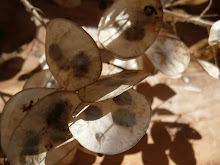
It's Latin name is Lunaria, deriving from the moon because of its round and silvery looking seedpod.


This morning we had drizzle and light rain showers - it's been quite dull with short spells of sunshine breaking through this afternoon.

The beautiful lime-green Corsican Hellebore has enjoyed a good soaking.


The Spring border is on a bank which faces North, and sits opposite our workshop wall - it's not in complete shade, and gets morning sun from the East and evening sun from the West.

First to appear are Snowdrops, followed by Primula vulgaris, Hellebores and Euphorbia - I may be tempted to introduce some Crocus next year?

I'm not a fan of bulbs in borders, there's too much danger when digging in for other plants with a trowel.

So as not to disturb the Snowdrop bulbs, I surround each clump with chunky bark pieces, which also adds a more woodland feel to the area.


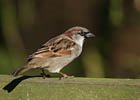
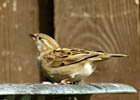
Whilst working, this lone Sparrow sat above - of course as soon as I came back inside the whole group (host) decide to come out of the hedgerow.

A bit nervous, or camera shy perhaps!

I could also hear a loud hum of Buff Tail Bumblebees - both on the Winter Clematis and on the bank, where they are happy to nest underground.


The Forsythia is not the only yellow shrub in Spring in my garden - there's Mahonia Japonica and Winter Jasmine which has just about gone over now.

I have two large clumps of drumstick Primula in pots coming into bud, and miniature Daffodils planted along the wall edge - though I notice many this year are coming up blind.


o
There's colour appearing on the rockery too.
o
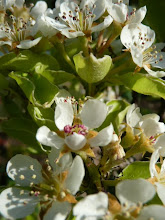
This tiny flowered white plant is pretty rampant, and if allowed will quite happily spread a mossy blanket of green across the whole area.
o
Soon purple Aubrietia will be in full bloom, amongst self-seeded(!) yellow Celandine.

I'm finding myself starting to like these out of focus colour blur pics!


o
All nature seems at work, slugs leave their lair,
The bees are stirring, birds are on the wing,
And Winter, slumbering in the open air,
Wears on his smiling face a dream of Spring!
o
In Springtime - by S T Coleridge

o

20/04/2010


my photos

TUESDAY GARDEN RAKE

I love my garden in April.

One of the plants which is looking its best right now is the yellow Primrose. The one above having the most perfect of flowers and foliage.


Thank goodness I've finally got around to moving those Raspberry canes!

Given to me by my Dad a few years back I ended up planting them in a spare patch which I had at the time. Enjoying the morning sun, they did well, too well infact and where growing high, were seriously restricting my view into the garden.

To restrict their spread underground, I'm experimenting by re-planting them in groups, in cheap small black storage containers, having drilled four drainage holes in each base.

They are now on a West facing fence, where they will get most sun late afternoon and evening.

I shall let you know how they do?


Another plant which I may have regrets in planting is Lysimachia ciliata, Firecracker. It's sure to spread like fury much the same as the two other varieties I have around the garden. I know I shall curse the day I ever saw it, but having a definite liking for dark foliage plants I couldn't resist it!

It's teamed up above with Forget me Not, another plant which once introduced to your patch, will self-seed and be with you forever onwards!


The birds in the garden are getting through food at a rate of knots! Stocks of bird food have been running perilously low.

My on-line order from Haiths arrived.

As much as I like to see Stock Doves and Woodpigeons around, I've bought Premium Wild Bird Food, a mix with no wheat, to deter them from using the birdtable.

Also, I've noticed an increase in finches around at the moment, so to attract more into my garden I've bought Native Finch, a mix containing oil rich seeds.


My garden with its ivy and high hedges provides lots of food, shelter and nesting sites for birds.

It sees many of the most common species ie House Sparrows, Dunnocks, Blackbirds, Starlings, Blue Tits, Great Tits, Robins and Wrens, so to spot something a little less ordinary and unusual to my garden, is always a treat.

Not having a long range zoom on my camera, with it taken through a window, and being cropped to the extreme, the photo above is not of the sharpest quality. The bird with its flitting movement, I'd say is some kind of Warbler?

On two occasions this week I've spotted a female Blackcap around the garden too.

o

17/04/2010


my photo

... the sun's still shining!

o

11/04/2010


my photos

LESSER CELANDINE

Lesser Celandine, a native wildflower or a weed?


Whatever, it spreads like wildfire in my garden!

Looking less intense on a bank in semi-shade, this native wildflower mingles well with the Deadnettle plant, both having complementing white blotch marks on their leaves.

o
Looking more intense on a rockery in full sun, this weed will put itself right where you don't want it!
o

24/03/2010


my photo

A WINTER STAR PERFORMER

The admirable Clematis Cirrhosa.

From November to April the Winter Clematis flowers flat-out, the month of March being no exception.

I have five well-established plants trailing over a wooden structure which separates the utility area from the main garden, three being var. Balearica, Wisley Cream and Freckles!

The South East has seen a hard winter this year, and the coldest on record for three decades. I am seeing a show of flowers on the Clematis more spectacular than ever.

Great for Bumblebees! The few who dare to 'brave it' in the coldest and darkest of months, can be seen buzzing around Clematis Cirrhosa in search of nectar.

o

22/04/2009


my photos

YELLOW DEADNETTLE AND BUMBLEBEE

Not as it may seem, the deadnettle is not related to the nettle family, but is a member of the mint family, hence it invasiveness in the borders. Even so I have found it fairly easy to pull out in areas where it is not wanted.

With its yellow-flowered angular stems and hairy non-stinging leaves, it looks lovely blending in with the fresh greens to be found in the garden at this time of year.


Many bees, bumblebees and moths are attracted to the flowers which contain nectar and pollen. I did spot a red-tailed bumble bee with its head in a flower too.

If you want to help the survival of the bee species, add it to your garden and you will discover why this plant is sometimes called Bee Nettle, a fitting name.


19/04/2009


my photos

AURICULA

A year or so back I acquired some very sorry looking Auriculas from my step-dad, in need of tender loving care. I decided what was best for them was to pot up in small plastic pots and to allow them whatever time necessary to rejuvinate.

Having always planted Auriculas into terracotta pots, I decided that once healthy I would plant these ones straight out into the garden. So that's what I did and they have been a great success.


Often there is a covering of white powder on the leaves of an Auricula, and in Auricula circles this is called 'meal'. The flower can have a circle of 'meal' on their faces too.


Have you any terracotta pot casualties after last winter's heavy rainfall and frosts? How about placing a broken pot at the foot of a plant giving the illusion of the flower sprawling out?

I have more than enough crocks and by using much loved, if not broken, old terracotta pots in this way, I can continue getting use out of them for a good few years to come, hopefully!


22/03/2009


my photo

MAHONIA

The flowers, tiny, fragrant and narcissi-like, on a stem. The foliage is like holly.

Otherwise known as the Oregon Grape and a member of the Barberry family, this evergreen shrub appears to do well in any situation, in full sun with dry soil or in shade with moist soil.

In the photo above, Mahonia is planted in a woodland situation in semi-shade. After a hard pruning, lovely new growth has sprung back. If no attention is paid to this shrub it will grow to be a monster!

Plant Mahonia near an open window or front door, its intoxicating scent will waft through the air as you sit or walk by, and winter bumble bees will pay interest in it too.


26/02/2009


my photos

HELLEBORE

The hellebore, flowering above, is doing very well. It is planted in a north facing position, in semi-shade. When planting I incorporated lots of homegrown compost, but once established the hellebore will tolerate most soils.

The dark purple 'lenten rose' is a welcome addition, the only herbacious perennial, alongside spring bulbs, flowering at this time of year in my garden. Plant preferably on a bank at more or less eye level, as hellebore flowers do have a tendency to bow their heads.

Three or five cut hellebore stems do look beautiful in a vase, if you can bring yourself to take them from the garden.


The beautiful illustration above is taken from Culpeper's Complete Herbal with The British Florist 1812.

21/02/2009


my photo

PRIMROSE

The Primrose gets its name from 'prima rosa' meaning first rose.

At the beginning of a new gardening year, the pretty 'primrose yellow' flowers are one of the first to come into bloom.

Last year, immediately after flowering, I divided clumps which had become congested to multiply along banks around the garden. Now my 'plants for free' are coming through, with great success.


28/04/2008


my photo

KERRIA

This double-flowered variety of Kerria (Japonica Pleniflora) is also known as Bachelor's Buttons, Jew's Mallow and Japanese Rose. A really pretty shrub to have around the garden at this time of year. I really like the combination of the 'custard powder' yellow of the blooms against the lime green of the leaves.

It will grow just about anywhere and if left to its own devices can reach up to 6ft tall. It will also spread by suckers which grow from its creeping underground root system. A plant which is best kept in check by pruning out all the old flowering stems.

William Kerr a protégé of Sir Joseph Banks, the famous 18th-century naturalist and plant collector, bought this particular variety back from China in 1804. By 1838 it was so common it was to be found in the gardens of labourers cottages!

This post is for my blogpal Daffy from Approaching 40, she has a delightful specimen in her garden too!

25/04/2008


my photos

PRIMROSE - I can't live without you, Early youth, Young love
POLYANTHUS - Pride of riches

I like to have some primroses or polyanthus in pots at this time of year, and I am not alone, the woodlice do too!

This year I opted for a mixed tray of white and a pink/orange colour, and I have made an interesting observation. The white flowers have been untouched and the pink/orange have been nibbled to death! Does this mean woodlice are repelled at the sight of white? I need to do more investigation? Has anyone else noticed this?


Great feast for the woodlice community in my garden, hundreds of them! Although extremely annoying in this instance, I really don't think woodlice do too much harm otherwise, so I will continue to invite them into my garden as a friend!

07/04/2008


my photo

PIERIS

Today the weather is a welcome improvement on yesterday, a mixture of sunshine, blue sky and marshmallow clouds, intermittently being overcast by huge threatening black clouds bringing with them sleet/hailstone showers. I took the photo of the fiery red growth on this Pieris 'forest flame' this afternoon whilst the sun was still out.

An evergreen shrub which I have growing in a pot, placed in partial shade. It likes an acid PH and has white flowers in Spring.

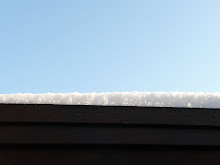
The photo below was taken yesterday, and look at the depth of snow on the bench. Now we don't often see this!

06/04/2008


my photo

SNOW

Correct me if I am wrong, but I think this is the first snowfall we have had this year in West Sussex? It is quite an unusual sight these days, and by lunchtime the ground had become blanketed in the white stuff and some quite deep drifts had formed in parts of the garden. By mid afternoon with the temperature rising, the snow quickly began to turn to slush.

I had to be quick to catch a photo of the weight of the snow on the white blossom of the Amelanchier which is also known as Snowy Mespilus.

28/03/2008


my photo

BERBERIS DARWINII

Also known as Barberry, this evergreen shrub was discovered in South America by Charles Darwin in 1835. If you want colour in your garden at this time of year, this is the shrub to have. It bears masses of small clusters of the brightest orange of flowers, and very often has a second flush in the Autumn.

Mine stands alone, but used as a full hedge its thorniness is a great deterrent, adding security to the garden. It requires careful pruning, as it has spiny holly-like leaves which will tear your hands to shreds if you are not wearing thick leather gardening gloves. This is one occasion when I do wear gloves, people who know me know that I would rather get dirt up my fingernails, although saying that, those latex disposable gloves come in handy for various tasks around the garden!

A great use for the prunings, is to lay them over your freshly dug over beds to keep the neighbours' cats off, don't get me wrong, I love cats, but my garden is not to be used as a WC for all and sundry!

24/03/2008


my photo

PULMONARIA - Thou art my life

Also known as lungwort, I believe because of the speckled leaves, although the leaves on mine aren't speckled? These have to be at the top of my list of favourite plants for Spring, one plant which I eventually want more of in the garden. I did originally have two plants, but now only have one, like so often you put in a plant, never to see it again!

This plant seems to like being situated in a dappled shade, semi-woodland position, mine is on a bank facing north, in moist soil.

20/03/2008


my photos

HAPPY EASTER

Have the happiest of Easters
And the springiest of Springs!


Violet is for faithfulness
Which in me shall abide
Hoping likewise that from your heart
You will not let it hide

The sweet scented and the dog violet are both classed as herbs, so can be used in a salad. Another use is in cordials, preserves and tea, and don't forget crystallised on the top of cakes and chocolates.

Violets can also used for medicinal purposes in the form of poultices to relieve ulcers, a tincture for sore throats, to ease the symptoms of catarrh and to lessen rheumatic pain.

The violet, such a tiny delicate flower with so many uses.

Watchfulness, faithfulness, I'll always be true

17/03/2008


my photo

WHITE VIOLETS - Let's take a chance

Since medieval times the violet has represented the month of March in the flower calendar because this was the normal month of its emergence.

I have discovered C W Groves & Son, a nursery in Bridport in Dorset, which specialises in various species of violet. Another place to visit, when we are next down that part of the country.

Another violet post coming soon.

Elaine from Feel My Felt asked if these violets are growing out of paving, and noticed the two other plants in the photo. Yes they are coming through a crack in the paving, they have self-seeded here. The two other plants in the photo, are sedum which will grow just about anywhere, and herb robert, which is a member of the geranium family, practically a weed in my garden. I am forever pulling it up, the whole plant has a very pungent smell!

24/02/2008


my photo

TETE-A-TETE - Regard, Unrequited love, Respect

How I like to get head to head with these little beauties, they are a ray of sunshine, especially after a long winter. A lovely dwarf daffodil, so ideal for all those narrow bare strips of soil around the place. Everyone loves big old blousy daffodils, including me, but I just haven't got the sort of garden where I can fit any in, or where I am not going to keep digging up the bulbs by mistake. I hate to be one to miss out, so these are perfect.

Notice that piece of old terracotta in the picture, well my soil is full of it, and shards of glass. For decades, dating back to the early 1900s, the area was the home of a thriving greenhouse and nursery trade, mainly chrysanthemums but also vineries, being demolished to make way for the building of homes in the late sixties, that very site being where I live.

07/01/2008


AURICULA THEATRE

As you have read in my previous post, I do like auriculas in old pots! I only have several plants of the same two varieties, but these are better than having none. The auricula plant is as tough as old boots, mine stay outside in their pots, come rain, shine, frost and snow, and they still come back to life, showing themselves in their full glory in the Spring.

Another one of my plans for the future is to have an auricula theatre, and to build up a collection of some of the more unusual varieties. There is a plethora of beautiful specimens out there to be had.


my photo

The picture above is of an auricula theatre we saw when we visited the National Botanic Garden of Wales, although we visited in the summer, so the theatre was showcasing a marvellous display of geraniums! If any of you are lucky enough to be in the Carmarthenshire area of Wales, this is definitely a place to visit.

The gardens stretch over 500 acres of beautiful countryside, in the site of the old Middleton Estate, a Regency parkland whose gardens, lakes, woodlands, undulating hills and wildflower meadows provide a variety of habitats and microclimates for plant and animal life to thrive.