OOO
t

Showing posts with label trees. Show all posts

01/05/2011

my photos

THE MONTH OF APRIL

Warmest since records began more than 350 years ago!

Heads of Cowslip.


Unlimited sunshine!

Red Admiral butterfly on fragrant Lilac.


Snow showers!

Amelanchier blossom.

o

31/01/2011


my photos

JANUARY

Good progress has been made in the garden this month.

With a lot of ivy pulling, cutting back and trips to the tip, the garden is looking much better for all our hard efforts.

My back is now killing me!


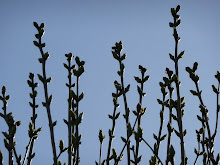
The top photo is Hawthorn.

The bare branches of the tree are noticably striking against the bright sunny skies we've been seeing this month, adding interest to the garden in Winter.

The photo above is Hazel.

I had been contemplating using it to join in with the Tree Year Project, but this along with the Hawthorn, are now in for a severe prune!

However, I shall be following Flighty over on his blog, as he watches his plot Hawthorn changing throughout the seasons, and Glo who is keeping a sharp eye on a Hazel.

In the meantime, I've signed the petition to Save England's Ancient Forests over on The Woodland Trust.


I've noticed too how the bare branches of Philadelphus are adding interest to the Winter garden ...


along with Grasses ...


and Rosehips.

25/01/2011


my photo

HAZEL CATKINS

Long male Hazel Catkins (also known as Lamb's Tails) as seen on a walk through Clapham Wood in January.


ooooooooooooooCicely Mary Barker

Click here for more photos from a walk in the woods.

O

22/04/2010


my photo

SNOW IN SPRING

The sunshine arrived weeks ago, and it just won't go away!

Flowering now in the garden is Amelanchier, also known as Snowy Mespilus.

The bees are loving it.

I recorded snow in April on my blog back in 2008, which did no favours to the blossom above.

There's nowt so queer as British weather!

o

09/04/2010


my photos

BLUE WITH A HINT OF BLACK

Above, the peachy pink buds of the Amelanchier tree, against sunny blue sky.


The purply, pinky blue of the Pulmonaria, in dappled shade.


And a hint of black.

Mr Blackbird taking a rest from his duties in the nest, amongst branches of the Hazel tree.

o

08/03/2010


my photos

BLUE

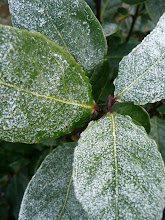
On a cold morning, in the warmth of the sun, branches in my garden took on a silvery glow.


Hawthorn.


Hazel.


Rose-hips.


Amelanchier.


A brisk North-Easterly wind.

o

23/10/2009


my photos

RAIN CLOUDS, A BLUE SKY, AND A RAINBOW

A morning of heavy downpours, and an afternoon of sunshine. A mixed bag kind of day for gardeners.


A Yew tree which sits at the top of the garden.

From this spot, if you look North, you can see the South Downs. Unfortunately if you look South, you cannot see the sea for rooftops!


With water droplets and sunlight, a rainbow forms.


14/10/2009


my photo


... leaves on the Amelanchier tree, turning to bronze in Autumnal sunshine.

o

24/06/2009


my photo

BLACKBIRD

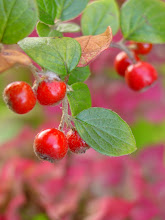
A fledgling up to its tricks, enjoying the berries from an Amelanchier tree.

y

06/04/2008


my photo

SNOW

Correct me if I am wrong, but I think this is the first snowfall we have had this year in West Sussex? It is quite an unusual sight these days, and by lunchtime the ground had become blanketed in the white stuff and some quite deep drifts had formed in parts of the garden. By mid afternoon with the temperature rising, the snow quickly began to turn to slush.

I had to be quick to catch a photo of the weight of the snow on the white blossom of the Amelanchier which is also known as Snowy Mespilus.

16/02/2008


my photo

EUCALYPTUS

I must confess that I wasn't really prised to my garden bench for a whole month, I was on an unforgettable trip to Australia. The photo above was taken from a distance and you can just make out the little fellow sitting up high in the tree. We were very fortunate to have seen this lovely koala and more of his friends and family, in their wild habitat on Kangaroo Island, which lies south of Adelaide. A lifetime ambition has now been fulfilled.

Eucalyptus, or gum trees, are the most characteristic feature of the Australian flora. It grows to 115 metres (375 feet) and has a smooth blue-grey trunk, and long, narrow leathery leaves with a bluish-green hue and many oil glands. Flowering during late summer, it also produces fruit shaped like spinning tops and coated with powdery wax.

Yorkshireman and Australian emigrant, Joseph Bosito, first discovered the volatile oils in Eucalyptus in 1848, and began distilling them. Commercial production started in Victoria in 1860 and, since then, out of the 300 species discovered, 30 have found medicinal use.

The tree's amazing ability to dry out marshy soil also led to its use in eradicating the malaria mosquito in Africa, southern Europe, and India.

14/10/2007


my photo

AMELANCHIER SNOWY MESPILUS

The weather today has been lovely, take a look at that blue sky in the photo, and I spent about 5 hours outside in the garden, with quite a few tea breaks thrown in! I have accumulated debris enough for another trip to the tip, I do compost a lot of my garden rubbish, but I can only do so much.

Gardening should really be done in blinkers. Its distractions are tempting and persistent, and only by stern exercise of will do I ever finish one job without being lured off to another.
Richardson Wright

Amelanchier can be used as a shrub but ours has been left to develop into a small multi-stemmed tree. In Spring it has white flowers before these turn into berries, ripening from red to purple-black. The leaves change various shades of colour during the year until Autumn when they have this beautiful bronze leaf colour, it is deciduous but the bark gives character to the garden in wintertime. The blackbirds and starlings love the berries, adults and juveniles alike.