OOO
t

Showing posts with label yellow. Show all posts

30/06/2011


my photos

RAIN STOPS PLAY IN JUNE

Would you believe at the end of May I was praying for rain?

Well my prayer was pretty much answered. After an exceptionally dry month in May, June has seen its fair share of heavy showers, with hail and a cracking good thunderstorm thrown in.

The garden's enjoyed endless soakings, and the water-butts are full.

Pretty yellow Lysamachia above (my Dad calls it Bombsite 'cos as a kid he remembers it growing on unused and neglected spaces).


A beautiful bronze Comma butterfly perching on Euphorbia seed-heads.

With a list of to-do jobs as long as your arm, this kind of weather can seriously hold you up.

With much to do and limited time, you begin to wonder whether you're ever going to get anything done?

Panic!

It's only by having time off work, and a spell of fine weather, I've been able to make some kind of headway.


There's been a lot of cutting back to do of early Summer perennials, to make room for annuals like Cosmos, Cerinthe and Calendula, which I've grown from seed.

Whatever size garden you have, there's never enough space!

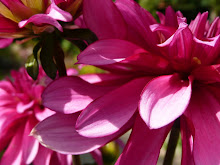
I wouldn't say no to a few more day lilies, like the one above.


Here's that Comma again, this time on the seaside-loving shrub Escallonia.

I've also noticed a rather handsome pair of Red Admirals taking nectar from Giant Scabious, and big hairy caterpillars that I've yet to identify?

There's a rather cute pair of baby blackbirds around too, getting pretty tubby with their endless feasting on Amelanchier berries, and sultanas!

I love my garden, and all those who love it too.


o

01/05/2011

my photos

THE MONTH OF APRIL

Warmest since records began more than 350 years ago!

Heads of Cowslip.


Unlimited sunshine!

Red Admiral butterfly on fragrant Lilac.


Snow showers!

Amelanchier blossom.

o

28/03/2011


my photos

SUMMER AND SOWING

This weekend the clocks go forward, and for us gardeners is the best time of the year because it means that at last the light has caught up with all our instincts to get out there and garden for as long as possible - Monty Don on Gardener's World.

How right you are Mr Don, and contrary to an earlier post I have been enjoying the gardening coming from your very large patch at Longmeadow.

I know I am going to be envious of your Dahlias come Autumn!

For well over a week now the UK has been basking in the most glorious sunshine, and today has been no exception and an excellent day for making a start on seed sowing - Beetroot, Tomato, Sweet Pea, Nasturtium, Calendula, and Morning Glory.

The seeds I ordered from Thompson and Morgan arrived yesterday, just in time for the weekend - Runner Bean Lady Di, Beetroot Kestrel, Tomato Vilma, Nasturtium climbing mixed and Patty Pan mixed with Cerinthe major Purpurascens to follow.

I also cut back and tidied foliage around the garden, and potted up cuttings from Coreopsis and Scabious - a simple and cost effective way of increasing stocks of perennial plants.


I love the colours of lemon and lime together, inside and outside.

Looking positively zingy and zesty in the sunshine have been the colourful blooms of the Mahonia and bracts of the Euphorbia.

Two seven-spot Ladybirds and butterflies of all colours have been emerging into the sunshine, a Comma, Holly Blue and Small White.

Also visiting, a pair of Goldcrests and the welcome return of Greenfinches to the garden.

13/03/2011


my photos

IN SPRINGTIME

I've been left feeling rather deflated after Friday night's Gardener's World - not sure why, I've been eagerly awaiting the return of Monty Don to the show for weeks.

Toby Buckland, Alys Fowler and Greenacre are no more, and the programme is now being filmed from Monty's own garden in Herefordshire.

It may be because having spent many hours thumbing through the pages, and drooling over the beautiful colour plates in his books The Jewel Garden and The Ivington Diaries, I'm already too familiar with the garden?

Having loved the garden at Berryfields, and being a big fan of Monty Don's approach to gardening, I'm sure to feel different once the season gets underway.

It's early days.

I'd be interested to know your thoughts?


I spent an hour or so this afternoon working on my Spring border - splitting Snowdrops in the green, and planting Honesty, plants grown from seed by my Dad.

Purple Honesty thrives in his garden of chalky soil, but up until now I haven't had much luck with this plant in my rich loamy soil.

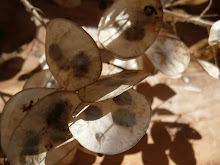
It's Latin name is Lunaria, deriving from the moon because of its round and silvery looking seedpod.


This morning we had drizzle and light rain showers - it's been quite dull with short spells of sunshine breaking through this afternoon.

The beautiful lime-green Corsican Hellebore has enjoyed a good soaking.


The Spring border is on a bank which faces North, and sits opposite our workshop wall - it's not in complete shade, and gets morning sun from the East and evening sun from the West.

First to appear are Snowdrops, followed by Primula vulgaris, Hellebores and Euphorbia - I may be tempted to introduce some Crocus next year?

I'm not a fan of bulbs in borders, there's too much danger when digging in for other plants with a trowel.

So as not to disturb the Snowdrop bulbs, I surround each clump with chunky bark pieces, which also adds a more woodland feel to the area.


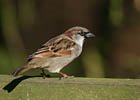
Whilst working, this lone Sparrow sat above - of course as soon as I came back inside the whole group (host) decide to come out of the hedgerow.

A bit nervous, or camera shy perhaps!

I could also hear a loud hum of Buff Tail Bumblebees - both on the Winter Clematis and on the bank, where they are happy to nest underground.


The Forsythia is not the only yellow shrub in Spring in my garden - there's Mahonia Japonica and Winter Jasmine which has just about gone over now.

I have two large clumps of drumstick Primula in pots coming into bud, and miniature Daffodils planted along the wall edge - though I notice many this year are coming up blind.


o
There's colour appearing on the rockery too.
o
This tiny flowered white plant is pretty rampant, and if allowed will quite happily spread a mossy blanket of green across the whole area.
o
Soon purple Aubrietia will be in full bloom, amongst self-seeded(!) yellow Celandine.

I'm finding myself starting to like these out of focus colour blur pics!


o
All nature seems at work, slugs leave their lair,
The bees are stirring, birds are on the wing,
And Winter, slumbering in the open air,
Wears on his smiling face a dream of Spring!
o
In Springtime - by S T Coleridge

o

14/02/2011


my photos

WINTER JASMINE

A pretty shrub to brighten up the garden in the bleak of midwinter is Jasminum nudiflorum, commonly known as Winter Jasmine.

You may well think it ordinary, but do you know of the interesting history it has?


More often than not these days I find myself snapping away with the camera, when I really should be gardening!

I like the blurry effect these two photos have taken on.

You could compare the yellowness of the Jasmine to a Summer's day - William Shakespeare Sonnet 18.

Happy St Valentines Day!

o

20/04/2010


my photos

TUESDAY GARDEN RAKE

I love my garden in April.

One of the plants which is looking its best right now is the yellow Primrose. The one above having the most perfect of flowers and foliage.


Thank goodness I've finally got around to moving those Raspberry canes!

Given to me by my Dad a few years back I ended up planting them in a spare patch which I had at the time. Enjoying the morning sun, they did well, too well infact and where growing high, were seriously restricting my view into the garden.

To restrict their spread underground, I'm experimenting by re-planting them in groups, in cheap small black storage containers, having drilled four drainage holes in each base.

They are now on a West facing fence, where they will get most sun late afternoon and evening.

I shall let you know how they do?


Another plant which I may have regrets in planting is Lysimachia ciliata, Firecracker. It's sure to spread like fury much the same as the two other varieties I have around the garden. I know I shall curse the day I ever saw it, but having a definite liking for dark foliage plants I couldn't resist it!

It's teamed up above with Forget me Not, another plant which once introduced to your patch, will self-seed and be with you forever onwards!


The birds in the garden are getting through food at a rate of knots! Stocks of bird food have been running perilously low.

My on-line order from Haiths arrived.

As much as I like to see Stock Doves and Woodpigeons around, I've bought Premium Wild Bird Food, a mix with no wheat, to deter them from using the birdtable.

Also, I've noticed an increase in finches around at the moment, so to attract more into my garden I've bought Native Finch, a mix containing oil rich seeds.


My garden with its ivy and high hedges provides lots of food, shelter and nesting sites for birds.

It sees many of the most common species ie House Sparrows, Dunnocks, Blackbirds, Starlings, Blue Tits, Great Tits, Robins and Wrens, so to spot something a little less ordinary and unusual to my garden, is always a treat.

Not having a long range zoom on my camera, with it taken through a window, and being cropped to the extreme, the photo above is not of the sharpest quality. The bird with its flitting movement, I'd say is some kind of Warbler?

On two occasions this week I've spotted a female Blackcap around the garden too.

o

17/04/2010


my photo

... the sun's still shining!

o

11/04/2010


my photos

LESSER CELANDINE

Lesser Celandine, a native wildflower or a weed?


Whatever, it spreads like wildfire in my garden!

Looking less intense on a bank in semi-shade, this native wildflower mingles well with the Deadnettle plant, both having complementing white blotch marks on their leaves.

o
Looking more intense on a rockery in full sun, this weed will put itself right where you don't want it!
o

27/02/2010


my photo

... yellow Mahonia fills the air with a sweet scent of Honeysuckle.

o
15/02/2010


my photos

PRIMROSES AND BARGAIN BUYS

It's already the middle of February and this is the first post on my blog for 2010!

What with recovering from an operation in September (all heavy duties in the garden off limits), constantly tired with working my day job, and our five week trip to Australia with Christmas inbetween, my garden at present is no Eden, be sure of that!


To put to rights, I've made a start in buying these lovely primroses after a quick visit to a local Wyevale garden centre yesterday. They are now planted up, and should do a very good job of brightening up a dull space around the front.

I had just enough time to pick up a large Tubtrug, half price at £3.99. They come in really useful for all sorts of jobs around the garden. For mixing compost, carrying water, cutting and deadheading, potting up, as planters, the list of uses is endless.

Failing miserably to make a swift exit before doing any more damage to my purse, I spotted and consequently bought a pair of woollen Thinsulate gloves, also half price at £2.99. I do find wearing gloves in the garden restrictive but these are fingerless, and today they came in really handy for keeping my hands all toasty and warm.

o

06/11/2009


water - important for any individual living thing.


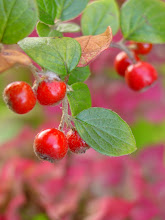
berries - important to encourage birds and wildlife into the garden.

my photos

Flowers, leaves and berries of the Hypericum.

o

04/11/2009


my photo

NASTURTIUM

The nasturtiums are continuing to romp away happily, doing me a great favour this year by covering up two heaps of compost I plan to move in the Spring. These are the climbing variety, and their growth spreads further than most varieties of Nasturtium. Originally seeds potted up by me, they continue to self-seed in situ every year.

It looks like these plants have survived being decimated by the Small/Large White butterfly, but will be knocked back by our first frosts.

Wikipedia says, Nasturtium comes from the Latin nasus tortus, meaning twisted nose, in reference to the effect on the nasal passages of eating the plants.

It's amazing the funny facts you learn when you have a blog!

o

04/07/2009


my photos

LYSIMACHIA - YELLOW LOOSESTRIFE

Lysimachia punctata, a perennial with whorls of buttercup-yellow flowers which reaches medium height in a border. Mine is situated in a sunny position and seems happy enough, although I would say, with lack of moisture, it does possibly go to seed more quickly than it would in a semi-shade position.

On a recent visit to Barrington Court in Somerset, owned by the National Trust, I noticed it was being used alongside a stream, which seemed to suit this plant very well.


Over the years I have tried to restrict the use of yellow around the garden but having inherited the aforementioned yellow Lysimachia, yellow shrubs such as Hypericum and the bog loving yellow Iris pseudecorus, the only way to completely elimate it would be through much hard work. Anyway, why should I go to all the trouble? Each in their own right makes a great addition to any garden, most noteably a cottage style one, and yellow plants do look great when planted alongside the cool colours, and even with a hot orange!

I know the great late Christopher Lloyd found great pleasure in mixing every colour under the sun together, and having visited his beautiful gardens at Great Dixter rate his ideas with much esteem, but I myself find yellow so difficult to get right alongside the other colours in my garden.

As you can see by the photo above, it is not impossible, the hot yellow of Lysimachia against the cool cream of Iris, makes for a perfect combination.
y

18/06/2009


my photos

CEPHALARIA - GIANT SCABIOUS

Giant being the operative word! This plant requires a lot of space.

A hardy perennial with pincushion heads of lemon-yellow flowers. A lovely addition to a cottage style garden, and makes a pretty stem for cutting. Its nectar is loved by both butterflies and bees.


The weather here in the South has been gorgeous, with warm, sunny days, with an odd blip here and there!

With longer daylight hours, evenings have been spent titivating, with more serious gardening only happening on days off.

Maybe now's the time to sit back and enjoy the fruits of one's labour!

u

24/04/2009


my photos

LEMONS AND LIMES

A lemon shade potentilla at the front of a border. A hardy perennial which is long flowering and will self seed around the garden.


A lime shade euphorbia, in the middle of a border. A compact, suckering variety which can be useful as ground cover. Will tolerate dry shade and looks great in a woodland setting.

Always be cautious when handling euphorbia, the sap is poisonous and irritates the skin.


22/04/2009


my photos

YELLOW DEADNETTLE AND BUMBLEBEE

Not as it may seem, the deadnettle is not related to the nettle family, but is a member of the mint family, hence it invasiveness in the borders. Even so I have found it fairly easy to pull out in areas where it is not wanted.

With its yellow-flowered angular stems and hairy non-stinging leaves, it looks lovely blending in with the fresh greens to be found in the garden at this time of year.


Many bees, bumblebees and moths are attracted to the flowers which contain nectar and pollen. I did spot a red-tailed bumble bee with its head in a flower too.

If you want to help the survival of the bee species, add it to your garden and you will discover why this plant is sometimes called Bee Nettle, a fitting name.


22/03/2009


my photo

MAHONIA

The flowers, tiny, fragrant and narcissi-like, on a stem. The foliage is like holly.

Otherwise known as the Oregon Grape and a member of the Barberry family, this evergreen shrub appears to do well in any situation, in full sun with dry soil or in shade with moist soil.

In the photo above, Mahonia is planted in a woodland situation in semi-shade. After a hard pruning, lovely new growth has sprung back. If no attention is paid to this shrub it will grow to be a monster!

Plant Mahonia near an open window or front door, its intoxicating scent will waft through the air as you sit or walk by, and winter bumble bees will pay interest in it too.


03/03/2009


my photos

WINTER

... white


... bright


... delight!


21/02/2009


my photo

PRIMROSE

The Primrose gets its name from 'prima rosa' meaning first rose.

At the beginning of a new gardening year, the pretty 'primrose yellow' flowers are one of the first to come into bloom.

Last year, immediately after flowering, I divided clumps which had become congested to multiply along banks around the garden. Now my 'plants for free' are coming through, with great success.


27/07/2008


my photos

SUMMER SUNSHINE

The hottest day of the year so far - 31 degrees. It may not sound a big deal to some of you living in the parts of the world you do, but for here in the UK, after the summer experienced so far, this temperature is positively tropical!

One of three plants basking in the summer sunshine today is Coreopsis grandiflora Mayfield Giant which can tolerate dry conditions, and flowers on and on, although does need deadheading to keep flowering to its maximum potential.


The first marigold of the year. These came out of a mixed pack of annuals given to me by a friend, sown late so only just starting to produce flowers. I always start the seeds off in pots and then transplant to where I choose in the garden. This year I have planted on into wooden troughs, facing east. When in containers water when necessary.


Nasturtium, one half of the variety St Clements, which is happy to be in dry soil. A lovely mix of yellow and orange, zingy citrus colours. Perfect for brightening up a salad and your day!