OOO
t

30/10/2007


my photo

NERINE common names include Jersey or Guernsey Lily and Spider Lily

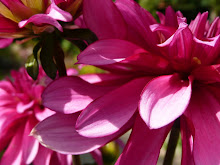
I was given this plant by a friend who was dividing hers, and to be quite honest it hasn’t done a thing, up until now that is. The other day I had quite a shock to see it flowering as it had been relegated to an out of the way corner of the garden. I must say it is beautiful and is an added a splash of lovely pink, which when you think of it, a colour not seen in abundance at this time of year in the garden. I believe this is Nerine bowdenii, a bubblegum pink variety.

Nerine bowdenii, sometimes called the Jersey Lily after Lily Langtry.

Others just holding on to flower in my garden are pale blue scabious, sunflower stella, salvia black and white, sedum, white gaura, white osteospermum and purple campanula.

23/10/2007


my photo

STRANGE PHENONOMEN

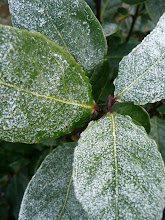
The other weekend when we had the rain showers and the gardens were full of glistening cobwebs I took this photo of my holly bush. When I uploaded the photo onto my computer I noticed what looked like a frog sitting on a branch, I went back outside to take a look but I couldn't pinpoint exactly which part of the bush I had taken the photo. I know on film you can sometimes get two pictures overlapping but this was on digital and my memory card didn't have any photos of frogs on at the time. What do you make of it, is it a trick of the eye and just leaf and stem, looking at it does freak me a little.

22/10/2007


my photo

MORE BIRD FOOD

Thanks to everyone for their comments on my posting Cats & Birds, they made great reading, my conclusion being to carry on as I have been, for me to enjoy the birds but just hope the cats don’t get to enjoy them too!

With this in mind I couldn’t resist a pack of these Gardman Hanging Feeders for Wild Birds when we popped into B&Q over the weekend, I like these feeders as you can hang them individually or stack them together and for under £5.00 I think they are quite good value for money, I have had these feeders before but not this particular selection:

Thistle Seed to attract Goldfinches, Greenfinches, Chaffinches, Coal Tits, Siskins and Bullfinches.
Robin Seed & Insect Mix to attract Robins, Blue Tits, Black Caps, Dunnocks, Great Tits, Coal Tits, Wrens, Finches, Thrushes and other species.
Blue Tit Seed & Insect Mix to attract Blue Tits, Great Tits, Coal Tits, Chaffinches, Greenfinches, Thrushes, Robins, Dunnocks, Black Caps, Wrens and other species.


Saturday 27th October is National Feed the Birds Day, designed to encourage people to feed the birds in their gardens. It is also a good opportunity for regular bird feeders to increase their feeding regime for winter. Feed the Birds Day is timed to coincide with the clocks going back as this marks the onset of the long, dark winter nights, when life can start to get a little harder for birds.


my photo

CATERPILLAR

Are there any caterpillar experts out there, does anyone know what this is? I think I have read that the hairy variety of caterpillar are moths? I discovered it clambering over my alchemilla mollis when I was having a garden tidy.


19/10/2007


CATS & BIRDS

Oh dear, today I witnessed one of the neighbourhood cats just having caught a bird in my garden, I know it is all part of nature’s cycle but I still get upset when I see it happening. The dilemma of mine is I like cats and I like birds, so I don’t chase the cats out of the garden and I encourage more birds into the garden. I do my best to site all my bird feeders so as not to make it too easy for the cats to pounce but they will still manage to spring upon unsuspecting birds on the ground.

I always worry when the fledgling birds are on the ground in the Spring, they are so vulnerable and they really can be sitting targets for a passing cat, but this year I was fortunate and didn’t notice any dead birds around the garden or in a moggies mouth.

Not being a cat owner, do cats actually eat their catch or do they just enjoy toying with it?

18/10/2007


my photo

HAITHS BIRD FOOD

My parcel from Haiths has arrived, I have treated my birds to a selection of goodies:


Bucket of Small Fatballs
Woodland Trust Forest Feast
Premium Wildbird Food


http://www.haiths.com

14/10/2007


my photo

AMELANCHIER SNOWY MESPILUS

The weather today has been lovely, take a look at that blue sky in the photo, and I spent about 5 hours outside in the garden, with quite a few tea breaks thrown in! I have accumulated debris enough for another trip to the tip, I do compost a lot of my garden rubbish, but I can only do so much.

Gardening should really be done in blinkers. Its distractions are tempting and persistent, and only by stern exercise of will do I ever finish one job without being lured off to another.
Richardson Wright

Amelanchier can be used as a shrub but ours has been left to develop into a small multi-stemmed tree. In Spring it has white flowers before these turn into berries, ripening from red to purple-black. The leaves change various shades of colour during the year until Autumn when they have this beautiful bronze leaf colour, it is deciduous but the bark gives character to the garden in wintertime. The blackbirds and starlings love the berries, adults and juveniles alike.

13/10/2007


my photo

AUTUMN

Photo taken in my garden after a morning of rain showers.

12/10/2007


BLACKBIRD

The blackbirds seem to have been hiding just of late, but this afternoon just as it was turning dusk, I noticed four having a great old scout around the garden, they really do look humorous as they run out from the undergrowth, hurriedly poke at the ground and turn over the leaf litter to find insects or earthworms and then hurriedly run back to find cover again. There is a lot in my garden for the blackbirds to feed on, plenty of earthworms in my soil, lots of shrubs with berries
on, and I buy dried fruit especially for them, so they will never go short.

Sing a song of sixpence a pocket full of rye
Four-and-twenty Blackbirds baked in a pie
When the pie was opened the birds begin to sing
Oh wasn't that a dainty dish to set before the King

I would have only had to of seen another twenty
and I would've had enough to bake a pie with, only joking!

10/10/2007


AUTUMNWATCH

Just in case you didn't know Autumnwatch is back on our screens on the 5 November, I really love it, and Springwatch too, I am afraid for the whole week I shall be glued to the screen at 8.00, so no blog postings then! I really like Bill Oddie presenting it along with Kate Humble, they make a great team. I wonder where Simon King will be this year, last year he was on Rhum with the red deer, it must be difficult thinking of another venue to top that, and remember the plight of the little baby seal, the supergeese and the lovely red squirrels. I can't wait to see what lovely little critters they come up with for this year.


picture from the web

Download Mini Oddie for your desktop http://www.bbc.co.uk/nature/animals/springwatch/minioddie/


09/10/2007


my photo

CORN

No this isn't my garden, it is the view from my dad's back garden, and what a view it is. He lives in Clapham, West Sussex on the edge of the South Downs.

06/10/2007


my photos

MORNING GLORY

The morning glory is native to tropical America. The botanical name Ipomoea comes from the greek, ips means worm and homois means being like, because of its pale, worm like stem.


No frost as yet so these two morning glory plants are still flowering, the pale pink is 'candy pink' and the cerise is an unknown variety as a friend of mine kindly gave me the seeds. If you leave them to go to seed they may become invasive around the garden, I don’t mind as I like them, but funny how I hate its common cousin, the dreaded bindweed!


Small quantities of substances similar to the hallucinogenic drug LSD are found in the seeds of some species.

04/10/2007


my photo

CATERPILLAR

Thought you may like to see what has been going on in my garden today, not much left of the nasturtium plants!

This is the caterpillar of the large white butterfly, they are usually found in clumps.


my photo

HYDRANGEA - Thank you for understanding, Boastfulness, Heartlessness

At this time of year in my garden the hydrangea looks at its best, it seems to thrive with neglect, as it grows in the driest patch of ground and never gets watered, it lives on rain water alone, which I suppose this year it has had rather a lot of.

In most species the flowers are white, but in some species (notably H. macrophylla), can be blue, red, pink, or purple. In these species the exact colour often depends on the pH of the soil; acidic soils produce blue flowers, neutral soils produce very pale cream petals, and alkaline soils results in pink or purple.

29/09/2007


my photos

PLASTIC POTS

A lovely day in the garden, so an ideal opportunity for getting my many plastic pots washed, graded, dried and even colour co-ordinated ready to store over winter in preparation for seeds and cuttings next spring. I always feel very satisfied once this job is done, although not a job I relish, as stooping over a bucket of soapy suds plays havoc on my back.

28/09/2007


my photo

ALCHEMILLA MOLLIS

"This alchemists herb catches one single jewelled raindrop in every leaf and then exudes pearly tears along finely serrated edges long after the foam of lime-yellow flower has faded" - Val Bourne (Garden Writer).


I really love this plant, and today after frequent rain showers it was just the perfect time to take a photo of it. I have several little clumps dotted around where it has self seeded. If the plants look tired they can be cut right back and will soon be replaced with lovely new lime green foliage and when flowering has frothy yellow flowers, but do cut off when they go to seed if you don't want it all around your garden. They are known to like shade but mine do equally well in a sunny position.

Alchemilla mollis takes its name from the Arabic, meaning little magical one, due both to its reputation for having healing properties and because its leaves catch the morning dew. In the Middle Ages, the water collected from alchemilla leaves was believed to have magical properties.

26/09/2007


my photo

ASARINA

I love hanging baskets but I am rather lazy when it comes to keeping them watered, so asarina (sometimes sold as lofos) is the perfect plant for me. This annual is really versatile, the first year I had them climbing, but for the last few years I have had them trailing out of hanging baskets, all you need is one plant for each basket as they really fill out, like surfinia does. Each flower is trumpet shaped and after flowering they develop a lovely seed head.

The plant flowers from June to October, they do need watering, but if you miss a day or two they will pick up again, although you may have to pick off a few crispy leaves here and there. I manage to over winter my plants under cover, they do die down but little shoots will appear again in spring ready to be planted out again after the last frosts, ready for the forthcoming summer.

24/09/2007


RED SQUIRREL

On our recent visit to Jersey I was very keen to see more of our lovely native red squirrel, on our last trip I only saw one, but true to nature not a single one was to be seen during our whole break away. After telling myself I was not going to see one on this occasion, much to my surprise on our early morning run back to the airport I saw two in different locations, if you have never seen one they are much smaller than the grey squirrel and just like Squirrel Nutkin from the Beatrix Potter tales.

Unfortunately these endearing little creatures have found themselves on the UK endangered species list and without conservation could become extinct within the next 20 to 30 years. This is due to a combination of causes which include being under threat from the increasing numbers of the introduced American grey squirrel, the deadly squirrel pox virus carried by the grey and a loss of woodland habitat.

It is estimated that only 140,000 remain, compared to 2.5 million greys.

14/09/2007


my photo

DOCTON MILL & GARDENS

If you are ever down Devon way take time to visit Docton Mill & Gardens which is situated in the Speke Valley, we visited in June and the garden was a delight, the day we visited the rain didn't let up but we didn't allow it to dampen our spirits. Highlights included magnificent herbaceous borders, a river walk with a superb bog garden, which incidently is described in Rosemary Verey’s book ‘Good Planting’ and a woodland walk, in fact every step you take from entering and exiting the garden you will come across something that will interest you.

Even if gardening isn’t really your thing you can still view the historic mill although it ceased working in 1910, simply because it ran out of business, its last big customer was Gifford the Baker, who is still in business today in nearby Hartland.

If all else fails there is a lovely tearoom which is situated in the house, they have a vast range of hot and cold food, our choice being warm scones, strawberry jam and lashings of clotted cream and a refreshing pot of tea, each! And, if you love dogs, you may see two Labradors mooching around the gardens too, and on exit there is a small plant sales area.

One final thing to mention, to get there you do have to drive down some pretty precarious country lanes, not really suitable for any nervous drivers out there.


my photos

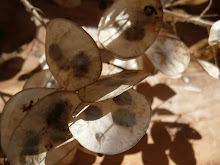
SEEDHEAD

I love everything about the summer, the sunshine, the long days and of course the lovely blooms which give so much colour to the garden, but at this time of year as the days get shorter and the garden is starting to look past its ultimate best, now is the time to start admiring what has been in your garden, and this is what you may discover.

I took these pictures just before dusk started to fall and I think you will appreciate that they really do capture the beauty of autumn. Notice too the spider's web, at this time of the year they are everywhere in the garden and more often than not you forget and get entangled in the sticky mess, not a pleasure if you are a bit sensitive to spiders like me!

1st picture is cephalaria gigantea (giant scabious) which has lovely pale yellow flowers, it needs a lot of space to grow into, mine is in a metre square plot and it has filled it, a lovely plant if you have the room.

2nd picture is aquilegia which I do love, but only plant it if you do, as it will self seed everywhere. I have many different varieties in my garden ranging from pale pink, dark purple and yellow.

12/09/2007


my photo

GREY SQUIRREL

We have lived in our present home since 1998 and as we have a small wooded area in our garden, over the years I have always thought it strange that a squirrel had never discovered it, well not until now that is. I am in two minds about our little visitor, you could say he is just a rat with a bushy tail, but I look at him and think how cute he is and we have already christened him 'Secret Squirrel', but on the other hand is he going to reek havoc around the garden big time once I start to plant bulbs, already he has been having fun turfing compost out from my troughs and I am convinced on the quiet he has been eating the fat balls from my starling, not squirrel proof feeder.

I have struggled to get a good picture of him, I tried again today but he wasn’t having any of it and leapt over my compost bins, onto the fence, then the shed, bolted up one side of the roof (we do live in a bungalow) and flew off the other side, they can literally fly. This picture was taken the other day and he is nibbling on a monkey nut which I suspect he has picked up from a neighbour's garden.

Many years ago my mum had a resident squirrel which used to come up to her patio doors, never let himself in, but for his troubles would be rewarded with the occasional chocolate biscuit of all things, he did look cute though, first twirling the biscuit around in his paws and then so neatly nibbling all around the edge. Then after all the encouragement she had given to it, would then expect sympathy from me when he uprooted all her pots to bury his finds.

11/09/2007


my photos

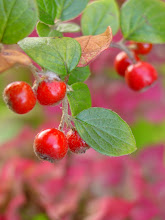
WINTER BERRIES

This time of year can be good in the garden for us, although this time of the year can be especially good in the garden for birds, as a gourmet menu awaits them; the more discerning residents will choose the red berries first, then onto the orange ones and then the yellow, if they are really peckish!

09/09/2007


my photos

FROG 2

I couldn’t resist posting a couple more photos of two more lovely frogs recently seen in my garden, it should be the last ones you see for this year as in a month or two they will be going into hibernation before it gets too cold for them. If the weather is favourable by around February time they should start to re-emerge, this is when they will go in search of water and will start spawning immediately.

Q. Why are frogs so happy?

A. They eat whatever bugs them.

07/09/2007


my photo

VERBENA BONARIENSIS

I first took notice of this plant when I saw Alan T using it on one of his gardening programmes, I loved the way it acted as a screen but that you could also see through it as well. Since introducing it into my garden, originally sowing by seed and potting on to make my own plants, I have developed a love/hate relationship with it; I love it because it encourages lots of butterflies, bees and even the hummingbird hawk moth, I hate it because it is prone to self seeding itself all around the garden giving me a lot of extra work pulling up seedlings from every crack in the paving!

05/09/2007


my photo

STRAWBERRY

… not ready, nearly ready, definitely ready, for eating!

These strawberries are from plants which my dad gave to me shortly after we moved here, not the original ones, as every two or three years I start off new plants from the runners, it is very easy to do. I use lovely old terracotta pots for this purpose, and just hide them amidst the foliage until the time comes when I can cut the little runners free. The strawberries hardly ever make it to the kitchen as I just eat them as I go around the garden, but I do have to find them quickly, more often than not I find that the woodlice have beaten me to it!

04/09/2007


my photo

ROSES - Grace

These beautiful roses were given to me yesterday by John's mum, this isn't the first lovely bunch I have had from her I hasten to add. There is nothing like fresh flowers to cheer you and your home up, although I never really treat myself to them, as I am always of the mind that it is best to spend the money on a plant for the garden, for everlong enjoyment!

my photo

COMMA

The sun came out today and so did the butterflies; this lovely comma was fluttering to and fro from flower to flower, but was in no mood to pose, and as I couldn’t spend hours on end chasing butterflies around the garden, this was the best picture I could get.Commas love feeding off nettle plants, so if you have a ‘wild’ space in your garden, where a weed or two wouldn’t really matter, don’t pull them up, leave them there for the butterflies.

The Comma is presently a relatively common butterfly but up until the 1940's it was only regularly seen on the Welsh borders.

02/09/2007


my photo

COREOPSIS - Always cheerful

This variety Grandiflora Mayfield Giant makes a lovely addition to any cottage style garden or in a prairie style garden mixed with tall grasses; if regularly deadheaded it will happily produce lots of sunshine yellow flowers from mid to late summer. Multiply this plant around your garden by taking cuttings, they are really easy to do. I have found coreopsis to be drought tolerant so they are perfect for any dry areas of your garden.


01/09/2007


my photos

BEATRIX POTTER AND HILL TOP

A trip to Hill Top is a must see for anyone visiting the Lake District. Beatrix Potter wrote many of her famous children's stories in this little 17th century stone house. Characters such as Tom Kitten, Samuel Whiskers and Jemima Puddleduck were all created here, and the books contain many pictures based on the house and garden.

There is a good example of traditional cottage garden, containing mainly old-fashioned flowers such as honeysuckle, foxgloves, sweet cicely, lupins, peonies, lavender and philadelphus. Roses grow ground the front door. Fruit still plays an important role in the garden - strawberries, raspberries, currants, gooseberries and rhubarb.

Beatrix Potter bought Hill Top in 1905 with the royalties from her first few books, written at her parents home in London, but inspired by her annual holiday visits to the Lake District, when she died in 1943, she left Hill Top to the National Trust.

my photo

CLEMATIS

Today, with much joy, I noticed a second flush on this clematis. I noticed this variety, Veronica's Choice, by chance in a local garden centre shortly after I lost my lovely mum to cancer five years ago. I believe I was meant to discover it, as her name was Veronica; when it is in flower I always think of her.